
By Michał Puchała · 2026-06-13 · 4 min read
The US just switched off a frontier AI model for foreigners - and showed who's in control
On 12 June 2026, a US Commerce Department directive switched off two Anthropic AI models for every foreign national overnight. The model is not the point - the switch is. It has been thrown before, and the lesson for European companies is to map their exposure now.
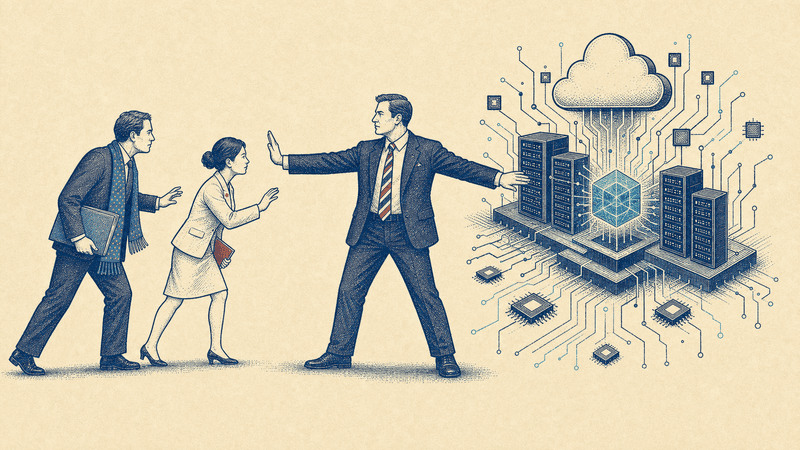
On the evening of 12 June 2026, a single government letter switched off two commercial AI models for every foreign national on earth. Anthropic received the directive at 5:21 PM ET and, by its own account, disabled both Fable 5 and Mythos 5 entirely to comply.
The restriction did not name a country, a company, or a sanctioned entity. It applied to all foreign nationals, whether inside or outside the United States, including Anthropic's own non-citizen staff. A product that hundreds of millions of people used was withdrawn from non-Americans overnight, by directive, with no negotiation and no appeal.
It's not really about the AI model itself (although it's a crucial part). It is more useful to read it as a story about who controls the technology you depend on.
What actually happened
The order came from the US Commerce Department as a national-security export control. According to Fortune's reporting, it bars Anthropic from distributing Fable 5 and Mythos 5 to any foreign national, with no geographic carve-out. The company's other models, including Claude Opus 4.8, were left untouched and remain available.
The stated basis was narrow. The government had identified a technique for bypassing the safeguards on Fable 5. Anthropic reviewed the demonstration, judged the disclosed weaknesses relatively simple and already available from competing models, and said the letter gave no specific detail about the underlying concern. The company disagrees with the directive, arguing that recalling a model used by hundreds of millions over a narrow finding would, applied broadly, halt new model releases across the industry.
Whether the order was proportionate is a debate for another day. What matters for a European business is simpler. A working commercial product became unavailable to non-US users on a few hours' notice, by government decision, and the customer had no say in it.
This has happened before, to other technology
This is just a new and stark example of something that's been happening before, although usually not to the European clients.
In May 2019, days after the Trump administration placed Huawei on the US Entity List, Google suspended Android licensing and services to the company, cutting it off from the software layer its phones were built on. That July, GitHub blocked private-repository and paid access for developers in Iran, Syria, Crimea, Cuba and North Korea, citing its obligation to comply with US export law. In 2025, the Commerce Department restricted sales of chip-design software to China, then rescinded the restriction six weeks later as a trade negotiation shifted, switching access on and off as a lever.
Each case has the same shape. Foreign users lost a tool they relied on, quickly, on grounds decided in Washington and outside their influence. The technology kept working. Their permission to use it did not.
The same logic sits underneath the hyperscaler infrastructure most European companies run on today. The difference with Fable 5 is only that it happened in a single evening, and that the line drawn was nationality itself rather than a sanctions list. A capability you cannot replace, supplied from a jurisdiction whose government can restrict it without consulting you, is a dependency whether the product is a phone operating system, a code repository, design software, or a frontier model.
Do not panic, but map your exposure now
None of this is an argument to drop American technology or to treat the United States as an adversary. It is not anti-American to notice that a supplier in another country answers to that country's government first. European businesses have US customers, US partners, and sound reasons to use US tools.
The measured response is to understand your exposure before a directive that names your sector or region arrives. Which of the capabilities your business cannot run without sit with a single foreign-jurisdiction vendor? If access to one of them changed next week, what is the fallback, and how long would moving actually take? Those questions are answerable, and answering them costs little.
Running the same assessment after your access has already changed is neither cheap nor calm. The companies caught out by the cases above were not the ones who had mapped their dependencies in advance. The lesson of 12 June is not that the sky is falling. It is that the switch exists, it has been used more than once, and the time to understand your own dependencies is now, while it is a planning exercise rather than an emergency.
Thinking about migration? Book a free consultation to discuss your situation.