
By Michał Puchała · 2026-06-30 · 8 min read
What a European Office Suite Actually Buys You
Euro-Office launched as Europe's open-source answer to Microsoft Office, and within days LibreOffice's foundation called it a de facto ally of Microsoft. The dispute is a useful lens on how much sovereignty a European office suite settles, and how much still rests on the file format.
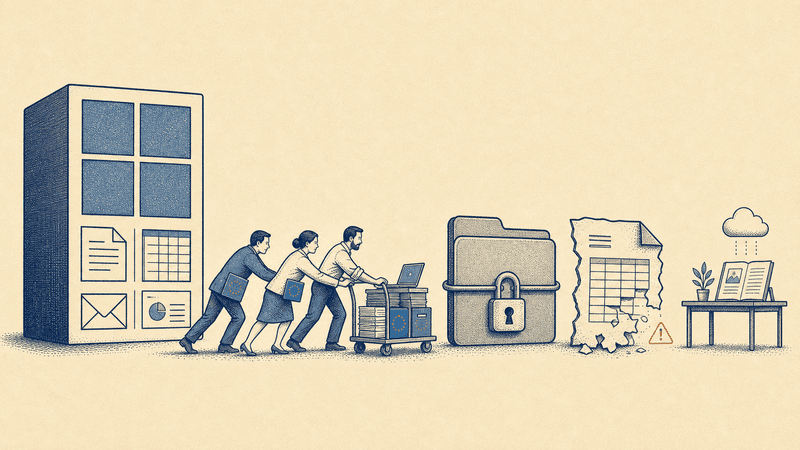
In June 2026, a group of European technology companies launched Euro-Office, an open-source productivity suite pitched as the continent's answer to Microsoft Office. Within days, the foundation behind LibreOffice - Europe's most established open-source office suite - published an open letter calling it "a de facto ally of Microsoft in its content lock-in strategy".
It was an unusually sharp accusation between two projects that, on paper, want the same thing: less European dependence on a single US vendor. The disagreement matters because it separates two things that usually get bundled together: moving to a European vendor you can host and govern yourself, and owning the format your documents are stored in. Euro-Office makes real progress on the first. The second is harder, and that is where the argument sits.
The default Europe is trying to leave
To see why the fight matters, start with the scale of the incumbent. Microsoft holds roughly 77% of the EU public sector's productivity software market, according to a report from the Open Cloud Coalition. In specific categories the concentration runs higher - up to 84% in collaboration tools and 90-92% in office productivity in some member states.
That share has built up over years of procurement, and it is now the default operating environment for governments, hospitals, and regulated businesses across the continent. When a single supplier sits under that share of an essential function, the question of alternatives stops being a procurement detail and becomes a strategic one. That is the backdrop against which both LibreOffice and Euro-Office are trying to offer a way out.
Two routes out, and why they are fighting
The two routes differ in shape. LibreOffice is a mature desktop suite, run by the non-profit Document Foundation, that defaults to the Open Document Format - an open standard not controlled by any single vendor. Euro-Office is newer: a web-first suite forked from OnlyOffice and backed by a coalition led by the German firms Nextcloud and Ionos, aimed squarely at European governments and businesses that want a locally developed option. Both suites can read and write the other camp's formats, so the disagreement is narrower than it first appears: it is about which format each one reaches for by default.
The flashpoint is the default file format. Euro-Office defaults to OOXML - the .docx and .xlsx family of formats originated by Microsoft - rather than to the Open Document Format. The Document Foundation's Italo Vignoli argued that a suite defaulting to a Microsoft-originated format is undermining the sovereignty it claims to deliver. Euro-Office's team acknowledged the concern and said it would focus development on improving Open Document Format support, with the goal of making it the standard over time.
So the two efforts weigh the same problem differently. The Document Foundation treats the open format as the point of the exercise. Euro-Office treats the European vendor as the immediate win and the format as something to improve over time. Both positions are defensible, which is part of what makes the dispute worth following.
What the file format still controls
Here the argument needs more care than the open letter gave it. OOXML is not, strictly speaking, a closed format. It was standardised as ECMA-376 and then published as an ISO standard, ISO/IEC 29500, in 2008, and anyone is free to implement it. Calling it "fully proprietary", as the Document Foundation does, overstates the case.
The real control is quieter, and it survives the standardisation. The published standard and the files Microsoft Office actually writes have drifted apart: Office defaults to the "Transitional" variant of OOXML, which keeps legacy behaviours the cleaner "Strict" variant was meant to retire, and it has done so for years. The de facto format is whatever Office writes to disk, and Microsoft's release schedule sets it. Every other implementation, LibreOffice and OnlyOffice and therefore Euro-Office, follows behind.
That catch-up carries real costs. It shows up as a table that reflows when a document moves between suites, a tracked-changes history that does not survive a round trip, or a spreadsheet macro that runs in one application and quietly fails in another. Individually these are small; together they are the everyday friction that pushes users back toward whatever application everyone else is running.
So the dependency is real, and it is also easy to overstate. Microsoft cannot reach into Euro-Office and switch it off, and nobody is suggesting it would. The pull is subtler: when most of the organisations you exchange files with run Office, your documents have to open cleanly in Office, so your formatting fidelity and your edge cases answer to a format whose behaviour you do not set.
There is a reasonable case for the choice Euro-Office made. Defaulting to the format the rest of the market already uses lowers the barrier to switching, because files stay compatible with every partner still on Office and an organisation can change vendor without forcing a format change on everyone it works with. Moving hosting, licensing, and control to a European, open-source-based suite is a genuine gain in its own right, even while the format question stays open. Euro-Office has said it intends to make the Open Document Format the default over time, which would close the part that remains.
Who is actually using what
For all the dependence, the move away from Microsoft is real where it is happening. The German state of Schleswig-Holstein is migrating around 30,000 government PCs to LibreOffice and Linux, the first German state to commit to a comprehensive shift, with public-sector IT provider Dataport and specialist firms handling support and macro migration. The move was driven in part by data-protection concerns about Microsoft 365 that European regulators had already flagged, and it is being run as a deliberate, multi-year programme, which is part of why it is being watched so closely.
The collaboration layer is moving too. openDesk, the sovereign workplace suite built by Germany's Centre for Digital Sovereignty, has passed 100,000 users, with federal bodies including the German pension and labour agencies beginning trials in early 2026 and the Robert Koch Institute among its adopters. These are substantial deployments in institutions that cannot afford to get continuity wrong.
They are also, against Microsoft's 77% share, still pockets. The direction is clear and the deployments are large enough to be more than symbolic, but Europe is still early in this shift. Anyone planning around "everyone is leaving Microsoft" is reading the trend ahead of the facts.
What this means for a mid-sized European organisation
Most organisations reading this are not a federal ministry, and few will be swapping 30,000 desktops next year. The useful part is the way the Euro-Office debate pulls sovereignty apart into layers. Moving your vendor, your hosting, and your licensing to Europe is worth doing and delivers real control. Owning the format and the standards your data lives in is a separate, slower piece of the same project, and it helps to be clear about which one you have actually finished.
That framing carries beyond the office suite. The same question - where does our data actually live, and in what formats and standards is it held - applies to the cloud infrastructure underneath it, which is usually the largest and least examined dependency of all. Cirran works on that infrastructure question rather than on desktop software, and the lesson from the office-suite debate holds at every layer: progress can be real and still partial, and it is worth knowing the difference. Independence means being able to leave on your own terms, with your data in a form you can take with you.
Thinking about migration? Book a free consultation to discuss your situation.