
By Michał Puchała · 2026-11-03 · 8 min read
Choosing a European Cloud: How to Check Its Environmental Claims
A European cloud move is a chance to examine environmental impact alongside data control. Learn how to compare electricity, water and hardware claims, check what a provider's calculator includes, and ask for evidence that applies to the services your business will use.
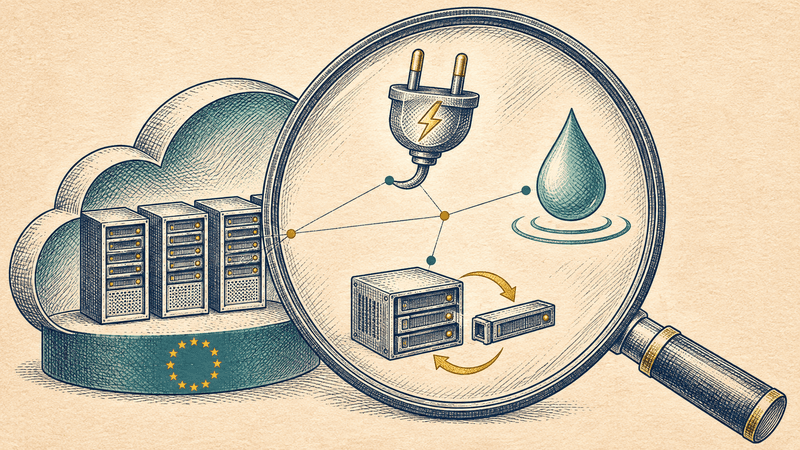
When you shortlist a European cloud provider, environmental claims deserve the same scrutiny as promises about data control. You need to know which services a claim covers, how it was measured and whether the evidence applies to the infrastructure you will actually use. A useful comparison should help you explain your choice to your board and give your IT team something it can verify.
On 27 October, OVHcloud published guidance on assessing cloud sustainability, covering measurement, hardware management and research. It is a useful starting point, written by a company describing its own approach. Our recommendation is to apply the same questions to every shortlisted provider, then examine the proposed application setup before claiming that a move will reduce environmental impact.
Start with the service you intend to buy
Ask each candidate to connect its environmental evidence to a concrete proposal: the cloud services, regions and backup locations your business would use. Request the reporting period, measurement method and any independent verification alongside each figure. A company-wide report can provide context, but the decision should identify where its findings apply to your proposed setup and where information is missing.
OVHcloud's October article illustrates why scope matters. It says its annual power-efficiency measurement covers 88% of the data centres it owns and operates, and names Apave Exploitation France as the auditor of specified environmental indicators. Those details give buyers a basis for follow-up questions; they do not establish that every customer service has had its complete environmental footprint independently verified. Source: OVHcloud's published guidance.
There is also a timely European policy context. The Commission says it proposed a common data centre rating scheme on 21 September 2026, alongside work towards minimum performance standards; consultation on the latter is open until 14 December. Existing reporting and proposed future standards are different stages, so a procurement document should describe each accurately. Source: European Commission.
For your shortlist, request the relevant reports now. Record the date and scope of any audit, including whether it checks selected indicators or a broader calculation. If a provider cannot supply a particular figure, mark it as unknown and decide whether that gap matters to your decision.
Separate building efficiency from application efficiency
Power Usage Effectiveness, usually shortened to PUE, compares a data centre's total energy consumption with the energy used by its IT equipment. A value closer to one means less energy is going to supporting systems relative to computing equipment. The Commission's data centre indicator definitions set out this calculation.
PUE alone cannot tell you how much energy your application will require. Consider a simplified example, using invented figures: an application needs 100 units of IT energy in a facility with a PUE of 1.2, giving an estimated facility total of 120 units. Another setup needs 80 units of IT energy at a PUE of 1.3, giving 104 units. Under those assumptions, the setup in the less efficient building uses less energy overall.
This example is an illustration, not a method for allocating an actual customer's footprint. Its practical lesson is to compare equivalent business work: processing the same orders, storing the same records or completing the same analysis. Keep required response times, backups and recovery arrangements consistent, and ask how the provider assigns shared infrastructure impacts to your service.
For a manufacturing company, we would start with one representative application and a defined workload. Ask the IT team to document the resources each proposed setup needs and any assumptions about growth. That gives the environmental comparison a business purpose and avoids selecting infrastructure solely because one facility advertises a favourable ratio.
Read the electricity accounting method
Electricity emissions can be reported using different methods. Under the GHG Protocol's Scope 2 Guidance, the location-based method reflects average emissions from the grids where electricity is consumed. The market-based method reflects qualifying contractual arrangements, including electricity products and energy certificates. These describe different aspects of electricity use and purchasing, so compare figures calculated on the same basis.
A low market-based result does not establish that the local grid has equally low emissions. The guidance explicitly distinguishes contractual claims from the physical flow of electricity. Ask for both methods where available, with the reporting year and explanation of the energy purchases, rather than treating a renewable-electricity headline as a complete environmental assessment. Source: GHG Protocol.
Scaleway offers a concrete example of why the distinction belongs in procurement. Its published calculator methodology says electricity impacts use a location-based approach, excluding its power purchase agreements from that calculation in accordance with its stated methodology. An assessment using another basis would need reconciliation before you could draw a fair comparison. Source: Scaleway's calculation methodology.
Ask your reporting team which method it needs before requesting figures from suppliers. Keep the underlying documents with the assessment, so a colleague can understand the result without reconstructing the sales conversation.
Put water use in its local context
Water Usage Effectiveness, or WUE, relates a data centre's water input to the energy consumed by its IT equipment. The Commission's indicator definitions also distinguish total water input from potable water input. Check the units and measurement boundary whenever you compare figures, and request the underlying annual volumes as well as the ratio. Source: Commission indicator definitions.
The location and season matter too. The European Environment Agency assesses water scarcity at river-basin and seasonal levels because annual national averages can conceal local pressures. That makes a country's general reputation an insufficient basis for judging a particular data centre's water impact. Source: EEA water scarcity indicator.
Translate this into a short conversation about the proposed site. Ask where its cooling water comes from, whether it uses drinking water and how demand changes during hotter months. Request an explanation of how the operator assesses local water availability and handles restrictions, with evidence specific to that facility.
Treat those answers as part of the decision alongside energy and continuity requirements. If two options meet your operational needs, documented water management can help distinguish them. Avoid turning a single low WUE figure into a claim about the sustainability of the whole service.
Include hardware and inspect calculator limits
Request an assessment that includes making the equipment as well as operating it. OVHcloud's published carbon calculator methodology separates manufacturing, electricity and operations, and describes how hardware configuration and expected lifespan enter its model. It is useful evidence of the calculation approach; the document's original product rollout descriptions should not be treated as a current coverage list. Source: OVHcloud's methodology paper.
Ask how manufacturing emissions are allocated over a server's life and among customers. Request the assumptions for shared equipment, storage and supporting systems. Where the provider uses estimates, ask which inputs are measured and which come from models or external datasets, then retain that distinction in your own assessment.
Scaleway's calculator documentation makes two useful limitations explicit: coverage is limited to certain products, and results can change as infrastructure, energy inputs or calculation methods change. Its product page also acknowledges missing supplier data and the use of estimates. A detailed dashboard still needs a coverage check against your proposed service list. Sources: Scaleway methodology and calculator limitations.
Request a sample customer report before committing. Check whether it accounts for the database, storage, backups and networking in the proposal, and ask how excluded services should be handled. Keep a copy of the methodology version with every comparison so that a later change in the calculation is not mistaken for an operational improvement.
Make the comparison part of the migration decision
We recommend evaluating environmental evidence after defining the application's operational and data-control requirements. A useful candidate must first support the services you need, your recovery objectives and the access arrangements your organisation requires. Then compare the environmental evidence for those viable designs, recording both strengths and unresolved questions.
For example, a manufacturer assessing its order-processing system could ask two shortlisted providers to describe the same production and recovery setup. Give each the same transaction volume, storage needs and retention requirements. Ask for an estimate covering an agreed period, with its assumptions, omissions and reporting method attached.
Use that exercise to produce a short decision record. Name the selected services and locations, explain which evidence influenced the choice, and assign someone to resolve missing information. State which conclusions are supported by measurements, which rely on estimates and which remain unproven.
If you proceed with migration, agree how you will check the result afterwards. Record a comparable baseline, include any temporary overlap between old and new systems in the assessment, and review the first reporting period once the new setup is stable. Describe an environmental improvement only to the extent the evidence supports it, while keeping the separate reasons for choosing European infrastructure clear.
Thinking about migration? Book a free consultation to discuss your situation.