
By Michał Puchała · 2026-06-02 · 8 min read
Europe's AI infrastructure investment wave: who is building, and what it means for sovereignty
Europe is attracting record AI infrastructure investment - SoftBank's €75 billion in France, Amazon's €33.7 billion in Spain, Google's €5.5 billion in Germany. But broader Europe holds only roughly 8% of global high-end AI compute. Announced capital and deployed sovereignty are not the same thing.
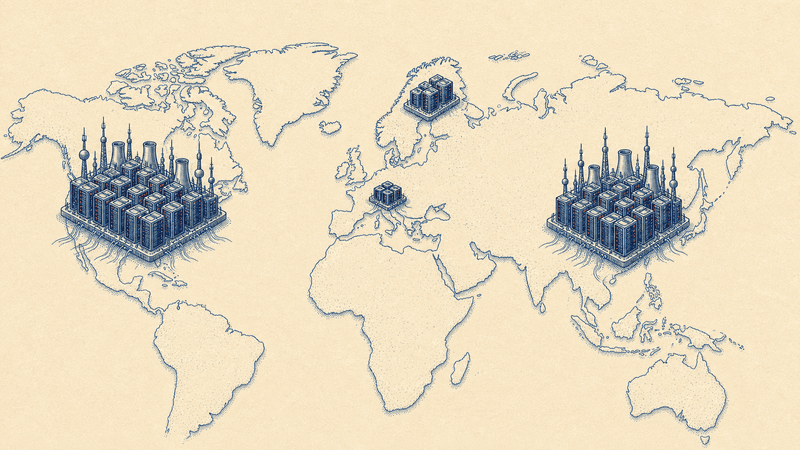
When SoftBank's Masayoshi Son announced plans to build up to 5 GW of AI data centre capacity in France at the end of May - a commitment of up to €75 billion - it made headlines across Europe as evidence that the continent is part of the global AI infrastructure race. The week before, Amazon had added €18 billion to an existing Spain commitment, bringing its total there to €33.7 billion. The month before that, Microsoft had announced €8.6 billion for a facility in Sines, Portugal. The announcements keep coming, and the figures keep growing.
The numbers are real. But the starting point they are improving from deserves equal attention, because the gap between announced investment and deployed sovereignty is wider than the headlines suggest.
Where Europe actually stands
The United States controls an estimated 74% of global high-end AI compute capacity. China holds 14%. The European Union - 27 countries with a combined GDP comparable to the US - holds 4.8%. Broaden the picture to include the UK, Norway, and the rest of non-EU Europe, and the figure reaches roughly 8%. That gap is not a recent development. From 2013 to 2024, cumulative private AI investment in the US exceeded $470 billion. The EU attracted roughly $50 billion over the same period - a 9:1 ratio that has been compounding for a decade.
The market concentration that resulted is visible in everyday infrastructure decisions. Three US companies - Amazon, Microsoft, and Google - account for approximately 65% of the EU cloud services market, according to the European Parliament Research Service. For most European organisations, digital infrastructure already runs on American-owned platforms, under terms set in Seattle, Redmond, and Mountain View. The current investment wave does not start from a level position.
The investment wave: who is building what
The scale of announced investment is genuinely unprecedented for Europe. SoftBank's France commitment - up to €75 billion for up to 5 GW of capacity, with a firmer Phase 1 of €45 billion and 3.1 GW by 2031 across three sites in Hauts-de-France - is the single largest AI infrastructure pledge the continent has received. Amazon's Spain commitment of €33.7 billion runs to 2035. Google has committed €5.5 billion to Germany between 2026 and 2029, covering a new data centre in Dietzenbach and an expanded campus in Hanau. Microsoft's €8.6 billion Sines facility, equipped with 12,600 Nvidia Blackwell Ultra GPUs, began initial operations in early 2026. AWS's European Sovereign Cloud in Brandenburg, a €7.8 billion project over 15 years, became operational in January 2026.
The important distinction is between general cloud infrastructure and AI-specific compute. Most hyperscaler expansion serves broad enterprise demand: storage, networking, managed services, productivity workloads. AI-specific compute - GPU clusters for model training and inference - is a smaller slice of the total announced spend, and the capacity it produces is controlled by the companies building it. An AWS data centre in Brandenburg still runs on AWS. European customers gain proximity and, in some cases, stronger contractual data residency guarantees. They do not gain ownership.
The SoftBank France project differs in character. It is not a hyperscaler expanding an existing platform; it is a large-scale bet on purpose-built AI compute in a European country, partly available to third-party tenants. But the capacity, once built, serves SoftBank's own AI strategy and commercial interests. It does not automatically translate into European-owned or European-controlled infrastructure, and the distinction matters when evaluating what sovereignty gains are actually on offer.
The scale problem
A single data point clarifies the competitive position. Alphabet reported Q1 2026 capital expenditure of $35.7 billion - a 107% year-on-year increase - and raised its full-year 2026 guidance to $180-190 billion. That single company's annual infrastructure budget is roughly comparable to the EU's entire InvestAI programme target of €200 billion, which runs through 2030 and covers all of Europe. Amazon, Microsoft, and Meta are deploying capital at comparable rates. The pace of US hyperscaler investment is not a static target that Europe is closing in on; it is accelerating.
The SoftBank commitment, while substantial, also carries qualifications worth noting. Analysts at TD Cowen flagged feasibility concerns given SoftBank's concurrent obligations - including its commitment to the American Stargate project - and Bloomberg reported that one SoftBank infrastructure loan was cut from $10 billion to $6 billion amid lender caution. The €75 billion figure is a maximum with forward-looking qualifiers attached; Phase 1 at €45 billion is the firmer number, and it runs to 2031. Data centre projects at this scale routinely take longer and cost more than announced. Announced capital and deployed capacity are not the same thing, and the distance between them is where most infrastructure commitments quietly shrink.
Europe's own play
The European Commission's InvestAI programme, formalised in early 2026, targets €200 billion in total AI investment across the EU through 2030. Within that envelope, €20 billion is earmarked for up to five AI Gigafactories - large-scale, purpose-built AI compute facilities at roughly €3-5 billion each. An expressions-of-interest call in spring 2025 drew 76 submissions from 60 sites across 16 Member States, representing €230 billion in proposed investments. Commissioner Virkkunen noted at the time that not all will materialise.
The open question hanging over the programme is whether these facilities will constitute genuinely sovereign compute - European-owned, European-operated, financed with European capital - or whether they will primarily consist of Nvidia hardware on European soil, under similar supply-chain dependencies as US hyperscaler infrastructure. That distinction has direct implications for what European AI sovereignty means in practice, and the programme's design does not yet resolve it.
The infrastructure investment does not exist in a vacuum. European-founded AI companies have already demonstrated that the demand for sovereign compute is real. Mistral in France builds and serves large language models that compete directly with US counterparts, and does so under French law and EU jurisdiction. Aleph Alpha in Germany has pursued a similar path, focused on sovereign AI for enterprise and public-sector clients. Both companies represent exactly the constituency that EU Gigafactories are meant to serve: organisations that want to train and deploy AI without routing their workloads through US-controlled infrastructure. Whether the programme delivers compute at the scale and cost these companies need is an open question, but the demand side of the equation is established.
Norway offers an instructive parallel. Despite being a non-EU country of five million people, Norway holds approximately 1.8% of global tracked AI supercomputer performance - a share comparable to France or Germany individually, and larger than most European countries that have made sovereignty a stated policy priority. The driver is straightforward: abundant and cheap renewable electricity, combined with deliberate investment in building and hosting large AI clusters, has made Norway a natural location for compute-intensive infrastructure. Norwegian energy economics make it cheaper to run a GPU cluster there than almost anywhere else in Europe, and the country has used that advantage to attract and build capacity at scale. The result is a compute footprint that is disproportionate to Norway's size or GDP. Norway's clusters are still largely Nvidia-dependent, which means the supply-chain question applies there too - but the lesson for the EU Gigafactory programme is clear: energy policy and infrastructure investment, aligned deliberately, can produce outsized results quickly. Applied at the scale of Germany or France, the same logic could shift Europe's compute position measurably within this decade.
What the landscape looks like by 2030
If the Phase 1 commitments announced in 2025 and 2026 are fully delivered, Europe's data centre capacity and AI compute base will grow substantially relative to where they stand today. The SoftBank, Amazon, Google, and Microsoft investments represent genuine additions to European infrastructure - more capacity, more GPUs, more availability zones for European workloads. That is real progress, even if the ownership structure is not primarily European.
The relative gap with the US is harder to close. Alphabet's single-company capex guidance already exceeds the EU's multi-year sovereign programme, and the other hyperscalers are on similar trajectories. Strong absolute growth in European capacity is likely; improvement in the relative 74% to 8% compute position is not guaranteed, and probably will not materialise in the near term.
China's position points to a distinction that the current investment wave has not yet addressed. China holds 14% of global high-end AI compute, but its infrastructure is predominantly domestically manufactured - Huawei Ascend and Cambricon chips, Chinese-controlled supply chains, Chinese-operated facilities. Europe's compute, including whatever the Gigafactory programme delivers, will be largely built on Nvidia hardware produced in supply chains Europe does not govern. Compute on European soil is not the same as compute under European control when the hardware depends on a single manufacturer and export control decisions made elsewhere.
The question facing European organisations in the next three to five years is not whether AI infrastructure investment is arriving - it clearly is - but what kind of infrastructure will result and who will control it. More data centres in Europe is necessary progress. European-controlled data centres, financed with European capital and built on supply chains Europe can actually govern, is the destination the current investments are pointed toward but have not yet reached.
Thinking about migration? Book a free consultation to discuss your situation.