
By Michał Puchała · 2026-08-04 · 8 min read
Europe is building seven AI gigafactories. Will mid-sized companies benefit?
The EU plans up to seven AI gigafactories backed by major public investment. The promise includes access for smaller businesses, but direct use will suit only some. Here is how mid-sized European companies could benefit, what may limit access, and what they can do now.
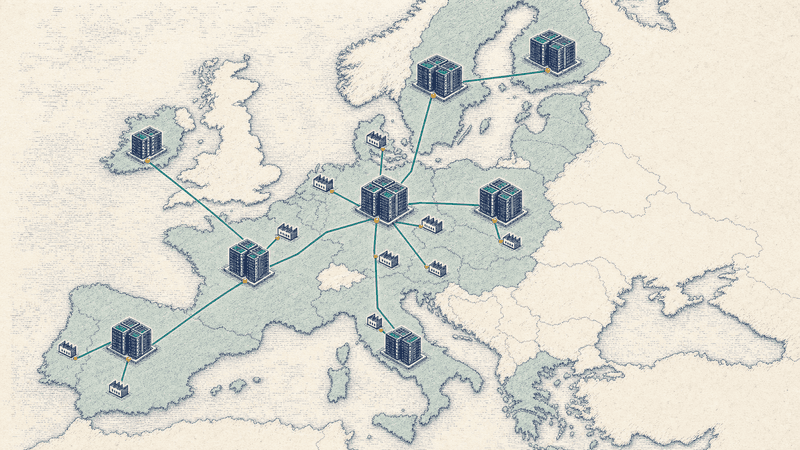
On 30 July, the European Union opened a call to establish up to seven AI gigafactories. These will be vast computing facilities designed to develop, train and operate the largest AI models. The headline promise is equally large: more European computing capacity, more control over critical technology and access for businesses of all sizes.
For a manufacturer, health-tech company or financial firm with 50–500 employees, the announcement raises a practical question. Will this infrastructure become something the business can actually use, or will it mainly serve governments, universities and specialist AI companies?
The likely answer is both. A small group of mid-sized firms could use the facilities directly. Many more will benefit through European AI products, sector-specific models and cloud services built on top of them. That wider benefit will depend on how well Europe turns raw computing power into services that ordinary companies can procure, integrate and operate.
What Europe has actually approved
The current call moves the gigafactory plan from policy into procurement. The EU is offering up to €10 billion in public funding and expects this to attract a further €20 billion in private investment, according to reporting by the Associated Press. Each facility is expected to contain at least 100,000 advanced AI processors. Together, the seven projects would more than double the computing power provided by Europe's existing network of 19 AI Factories.
The names are confusing but the distinction matters. Today's AI Factories combine supercomputers with data, technical support and access programmes. The future gigafactories will operate at a much larger scale, with enough capacity to handle the complete lifecycle of models containing trillions of parameters, from initial development to large-scale use. The European High Performance Computing Joint Undertaking says they will include high-capacity storage, networking, secure cloud access and specialist AI support alongside the processors.
The Commission's stated goal includes access for researchers, public authorities, industry and small and medium-sized enterprises. It also expects the projects to create sustained demand for European-designed processors and, eventually, manufacturing inside the EU. The Commission's gigafactory overview presents that domestic semiconductor capacity as a future result, so the first facilities will still depend heavily on advanced components sourced through international supply chains.
This will take time. The call closes on 12 November 2026, decisions are expected in early 2027, and construction should begin later that year. The published timetable expects operations to start within 18 months of construction, so the new capacity is unlikely to be available before 2028.
Which mid-sized companies can use the facilities directly
The EU uses "SME" more narrowly than many business conversations do. An enterprise with fewer than 250 employees can qualify, subject to financial and ownership tests set out in the European Commission's SME definition. A company with 250–500 employees may still feel mid-sized, but it sits above the staff threshold used for EU support programmes.
That boundary affects access. Under the current AI Factory model, the industrial access routes are free for eligible AI-focused SMEs and startups using them for innovation. Other companies can use commercial pay-per-use access. An ordinary manufacturer or healthcare business therefore should not assume that being below 250 employees automatically brings free computing time.
The current system gives us the best available guide to how gigafactory access may work. EuroHPC offers three industrial access modes. Playground access is intended for entry-level testing. Fast Lane covers projects needing up to 50,000 GPU hours, while Large Scale access serves projects above that threshold and requires technical and peer review.
The lighter route is genuinely accessible. Playground applications are assessed on a rolling, first-come basis, with a decision possible within two working days. Hosting teams provide onboarding for companies that have limited experience with supercomputing. Fast Lane access also includes expert support, but assumes that the applicant already understands high-performance computing.
Direct access therefore makes most sense for a company developing its own substantial AI asset. Examples might include a medical imaging model trained on carefully governed European data, an industrial model that detects faults across thousands of machines, or a multilingual financial model that must be tested under strict controls. A company that mainly wants to add a chatbot to its website does not need a gigafactory.
Why raw computing power is only part of the answer
AI adoption already shows a clear size gap. In 2025, 55% of large EU businesses used AI, compared with 19% of small and medium-sized businesses, according to Eurostat's 2026 digitalisation report. Computing capacity can remove one obstacle, but it does not prepare data, define a useful business problem or give a lean technology team the time to build and operate a model.
Supercomputer access also differs from buying a familiar cloud product. An applicant needs to estimate its computing requirements, show that the project is technically ready and explain why the work needs the requested allocation. Larger applications go through peer review. Once approved, the company still needs people who can prepare training jobs, manage data, evaluate model behaviour and turn the result into a reliable application.
Capacity itself can become constrained. The current Large Scale access page warns that some systems have limited availability and, as of early August 2026, lists the Leonardo system as unavailable for this mode because of high demand. Seven gigafactories would materially increase supply, but demand is also growing quickly.
The useful unit for most mid-sized companies will therefore be a finished service rather than an allocation of processor hours. That service might be a European-hosted language model with clear data terms, a diagnostic product trained for healthcare, a forecasting tool for manufacturing or a managed environment where a company can refine an existing model with its own data. The gigafactories matter because European companies building those products will have more local capacity available to them.
Where the wider benefit could appear
The first benefit is a stronger European AI supplier market. A model developer that can train and run its product on shared European infrastructure needs less capital to compete. Its customers gain another credible option for workloads where legal control, operational continuity or data location matter.
The second is sector-specific support. The present AI Factory network already points in this direction. EuroHPC lists facilities focused on areas including manufacturing, automotive, healthcare, finance, cybersecurity and agriculture. They combine computing with onboarding, training, model-development support and regulatory expertise. Extending that approach to gigafactory capacity would make the infrastructure far more useful than a large pool of processors alone.
The third is greater choice in how sensitive AI workloads are deployed. European capacity cannot remove every dependency: the chips, software components and specialist knowledge will continue to come from several countries. It can still give organisations more control over where their data is processed, who operates the environment and which legal framework governs the relationship.
There is also a procurement benefit. A company may never connect directly to a EuroHPC system, yet its software suppliers could use that infrastructure behind their products. Buyers will then need clear answers about the full chain: where the model was trained, where business data is processed, which subcontractors can access it, whether inputs are retained and how the service can be moved or replaced.
What companies can do before 2028
The gigafactories should influence planning, but they are not a reason to delay useful AI work. Europe's existing AI Factories are operational now, with 19 sites and 13 associated antennas listed by the European Commission. Companies can already examine Playground or Fast Lane access, find a sector-focused facility and test whether their project needs specialist computing at all.
Start with the workload rather than the infrastructure announcement. Decide whether the business needs to train a model, refine an existing one with private data or simply use a model through an application. Those three paths have very different computing, staffing and governance requirements.
Then map the data and operational constraints. Health information, financial records and industrial designs may require tighter controls than public product documentation. A useful assessment should cover data location, legal jurisdiction, operator access, model retention policies, service continuity and the ability to move the workload later.
Finally, ask prospective AI vendors how they expect Europe's new capacity to affect their services. A credible answer should explain the delivery path, not repeat the word "sovereign". The strongest outcome from the gigafactory programme would be a market where mid-sized European firms can choose capable AI services with clear control over their data and fewer avoidable dependencies.
The seven facilities can help create that market, but processors alone will not do it. Mid-sized companies will benefit when the surrounding access programmes, technical support and European suppliers make the capacity usable. The current AI Factory network offers an early test of whether Europe can deliver that final step.
Thinking about migration? Book a free consultation to discuss your situation.