
By Michał Puchała · 2026-07-07 · 6 min read
Leaving Your Cloud Provider Is About to Get Cheaper - by Law
From 12 January 2027, EU law bans the fees cloud providers charge customers who leave, including data egress. What the Data Act's switching rules actually guarantee, where the real migration costs remain, and how the date changes the arithmetic for a company weighing a move now.
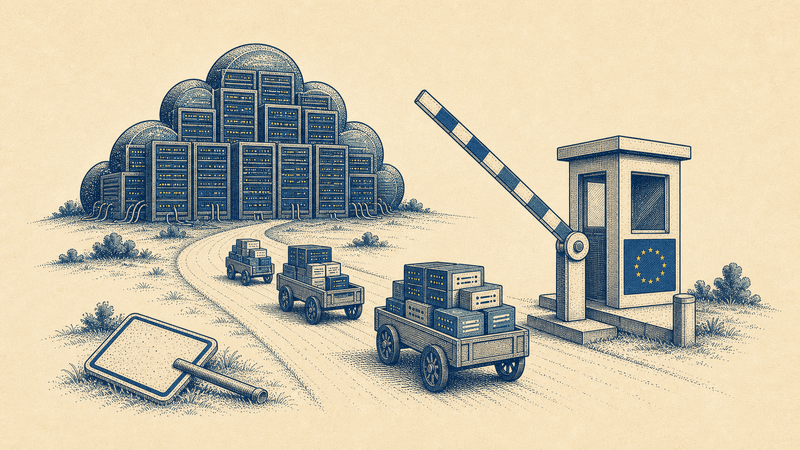
For as long as companies have run on the big cloud platforms, leaving one has carried a price tag of its own. Egress fees - the charges for moving your own data out - put an uncomfortable line at the top of every migration estimate and gave every "should we stay" conversation a reason to end early. That arrangement is now being written out of European law. From 12 January 2027, cloud providers may no longer charge customers for switching, and that includes charging you to take your own data with you.
The date is closer than it looks. A migration scoped in the second half of 2026 will typically execute during 2027, which means the rule change belongs in this year's planning conversations rather than next year's. This article sets out what the EU Data Act actually requires, what it deliberately leaves untouched, and how it changes the arithmetic for a company weighing a move.
What the Data Act requires, and when
The Data Act is a broad EU regulation about who can use and share data, but its most practical chapter for cloud customers is the one on switching. Since 12 September 2025, providers of data processing services - infrastructure, platforms and software sold as a service - have been obliged to remove the obstacles their customers face when they want to move to another provider or bring workloads back in-house. "Obstacles" is a deliberately wide word: it covers commercial barriers such as fees, technical ones such as closed export formats, and contractual ones such as terms that make leaving impractical.
This is worth pausing on, because it is a genuinely new kind of rule. European law has regulated how cloud providers handle data for years. It has never before regulated the act of leaving a provider. The Data Act treats switching as a right the customer holds, with defined timelines and a defined end to the costs - not as a favour the provider grants.
The fee rules arrive in two steps. Since the regulation entered into force in January 2024, providers have been in a transition period during which switching charges must shrink to bare cost. On 12 January 2027 the transition ends, and the charges disappear altogether.
The money: what can still be charged, until when
During the transition period, a provider may pass on only the costs it directly incurs in facilitating your switch - and it must be transparent about them and agree them with you in advance. From 12 January 2027, all switching charges are prohibited, including data egress fees. What remains chargeable is what you would expect: your normal service fees until the contract ends, proportionate early-termination fees in fixed-term contracts, and any additional help you ask for beyond what the law already requires.
The large US providers saw this coming and moved early. Google waived exit egress fees in January 2024, AWS followed in March, and Azure completed the set shortly after. Those programmes are real money - egress on a large estate could run to five or six figures - and they are worth using.
But as introduced in 2024, they came with strings. AWS granted credits valid for 60 days, within which the whole migration had to complete; Azure required customers to signal the intent to cancel their subscription before applying. A 60-day window suits a small estate, and is tight for a regulated company running a careful parallel migration. The right you hold from January 2027 has no such window - which is one reason the date matters more than the programmes.
The contract rules nobody reads until they need them
The fee ban gets the headlines, but the Data Act also rewrites what your cloud contract must say about leaving. The terms are specific. You may initiate a switch with a maximum of two months' notice. The provider then has 30 calendar days to complete the transition, extendable by up to seven months where that is technically unfeasible - and you may choose a longer period if that suits your plan better. The contract must define a minimum window in which you can retrieve your data, and guarantee erasure of what remains once that window closes.
The technical side has teeth as well. Providers must export your data in commonly used, machine-readable formats, and platform and software services must offer open interfaces for the move. For infrastructure services, the Commission's guidance goes further: when you switch to a service of the same type, the destination should deliver materially comparable outcomes for the features both services share.
The practical point is that exit has become an entitlement with deadlines, where it used to be a negotiation you started from a weak position. If your agreement renews between now and 2027, these terms belong in the conversation - not because you have decided to leave, but because a contract that already reflects them is cheaper to leave later.
What the law does not solve
Here it is worth being honest about the limits, because egress fees were never the real lock-in. The genuine costs of leaving a cloud platform are the proprietary managed services your applications grew around, the engineering work of refactoring them for another provider, and the time your team spends learning and testing the new environment. No regulation moves a workload for you. A company that treats January 2027 as the moment migration becomes free will be disappointed; what becomes free is the data transfer, which was rarely the largest line in the estimate.
The rules also have carve-outs worth knowing. Where you run services on two clouds in parallel as a standing arrangement, rather than transferring away, egress charges can still apply - the ban is about leaving, not about multi-cloud operations. Genuinely custom-built services sit outside the switching framework, and providers may still charge for help that goes beyond the legal minimum, such as converting data into a specific format or accelerating the move.
And providers will adapt commercially. Legal analysts already expect some to restructure their pricing to recover elsewhere what the switching line used to carry. The Data Act removes the toll booth; the road is still yours to drive.
What this means if you're weighing a move now
For a company already thinking about European infrastructure, the fee ban does not change the reason to move - it changes the cost of acting on it. The sovereignty case stands on its own: jurisdiction over your data, a defensible answer for your auditor or board, a contract governed by the law you operate under. What the Data Act adds is a firm date after which the most visible exit cost is zero and the contractual path out is standardised.
The timing arithmetic is simple enough to do on one page. Count forward from your next renewal, and count backward from January 2027. If your renewal lands before the ban, the new contract terms are your negotiating agenda; if your migration would execute after it, the egress line in your estimate goes to zero and the plan should say so. Either way, a move scoped this autumn lands in the world where these rules are fully in force.
None of this makes the decision for you. Some workloads are cheap to move and should have moved already; some are so entangled with proprietary services that the honest answer is to wait or to stay. The useful exercise is to know which is which before your renewal makes the question urgent - and that is an assessment, not a leap.
Thinking about migration? Book a free consultation to discuss your situation.